
 Discussion
Efgartigimod for immune thrombocytopenia
Last updated Oct. 20, 2025, by Lila Levinson, PhD
 Fact-checked by Joana Carvalho, PhD
What is efgartigimod for immune thrombocytopenia?
Efgartigimod is an antibody-based therapy being explored as a treatment to ease the symptoms of primary immune thrombocytopenia (ITP).
In ITP, the immune system produces self-reactive antibodies that target platelets — the cell fragments that help blood form clots — for destruction. This puts patients at an increased risk of bleeding. In most cases, the disease has no apparent underlying cause or trigger and is referred to as primary ITP.
Normally, a protein called neonatal Fc receptor (FcRn) helps stabilize and prevent the destruction of antibodies circulating in the bloodstream, including the self-reactive ones that drive ITP. Efgartigimod inhibits FcRn, potentially accelerating the rate at which ITP-driving antibodies are broken down and easing disease symptoms.
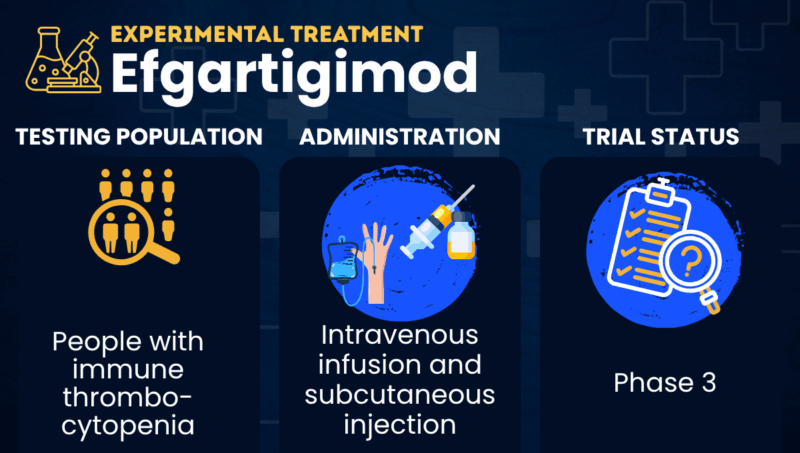
Argenx is developing an intravenous (into-the-vein) and subcutaneous (under-the-skin) formulation of efgartigimod for ITP. The therapy is currently in Phase 3 clinical testing. Japanese regulators have approved intravenous efgartigimod, sold as Vyvgart, for adults with primary ITP, but this indication hasn’t received approval elsewhere.
Vyvgart and the subcutaneous formulation of efgartigimod — marketed as Vyvgart Hytrulo in the U.S., Vyvgart SC in Europe, and Vyvdura in Japan — are approved in the U.S. and elsewhere for generalized myasthenia gravis (gMG) and certain other autoimmune conditions.
Therapy snapshot
Scroll horizontally to view all columns -->
| Treatment name: | Efgartigimod |
| Administration: | Intravenous infusion and subcutaneous injection |
| Clinical testing: | Currently in Phase 3 testing |
How will efgartigimod be administered in immune thrombocytopenia?
In clinical trials testing the intravenous and subcutaneous formulation of efgartigimod in people with ITP, participants received four weekly doses, given as intravenous infusions or subcutaneous injections. After this point, depending on their platelet counts, they could continue on a weekly schedule or switch to dosing every other week.
Efgartigimod in immune thrombocytopenia clinical trials
The intravenous and subcutaneous formulations of efgartigimod have been tested in a series of Phase 3 clinical trials involving adults with primary ITP. They are:
- ADVANCE-IV (NCT04188379), where 22% of participants receiving intravenous efgartigimod reached the primary goal of a sustained increase in platelet counts, which was significantly more than the 5% seen in placebo group. Efgartigimod-treated participants also had significantly longer periods of disease control — a median of two weeks compared with zero in the placebo group. The medication was also generally safe and well-tolerated.
- ADVANCE-SC (NCT04687072), where the subcutaneous formulation of efgartigimod failed to meet the study’s primary and secondary goals. Top-line data showed that 13.7% of efgartigimod-treated patients achieved a sustained platelet response, which was also seen in 16.2% of patients given placebo.
An open-label extension study of ADVANCE-IV, ADVANCE+ (NCT04225156), is ongoing. ADVANCE-SC also has an extension study, ADVANCE SC+ (NCT04812925), which may still be taking place.
Recruitment is also underway for ADVANCE-NEXT (NCT06544499), another Phase 3 trial testing intravenous efgartigimod in people with ITP. The participants will include around 63 adults with primary ITP that has lasted at least one year and haven’t responded sufficiently to at least one other therapeutic approach. Intravenous infusions of efgartigimod or a placebo will be administered for about six months. This will be followed by two one-year open-label extension periods, during which all the participants will receive efgartigimod. The study’s primary outcome metric will be the extent of disease control, or the proportion of patients in whom platelet counts exceed 50 billion platelets per liter for at least four of the six visits taking place in the last weeks of the first six months of treatment. Top-line results are expected in 2026.
Efgartigimod side effects
The most common side effects reported in the ADVANCE-IV trial testing intravenous efgartigimod in people with ITP were:
- headache
- blood in urine (hematuria)
- purple spots or discolorations due to bleeding under the skin (petechiae and purpura)
- generalized physical and mental fatigue (asthenia)
- high blood pressure (hypertension)
- nausea
- fatigue
Bleeding Disorder News is strictly a news and information website about the disease. It does not provide medical advice, diagnosis, or treatment. This content is not intended to be a substitute for professional medical advice, diagnosis, or treatment. Always seek the advice of your physician or other qualified health provider with any questions you may have regarding a medical condition. Never disregard professional medical advice or delay in seeking it because of something you have read on this website.

Related articles
-
Discussion
-
 Discussion
-
 Discussion
-
Discussion
-
 Discussion
-
 Discussion